
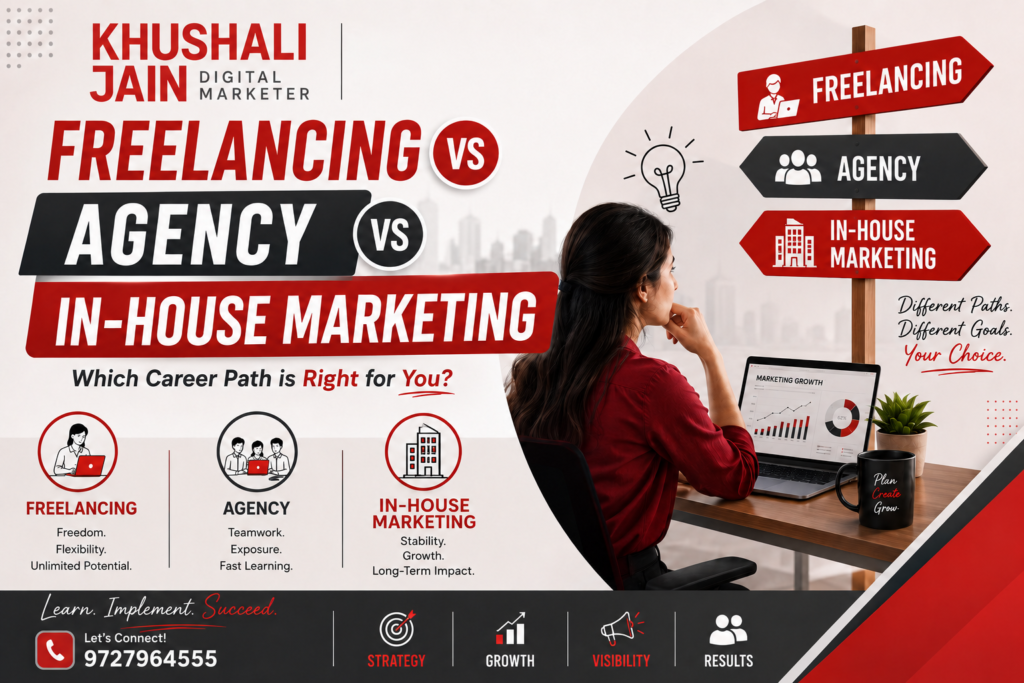
Freelancing vs Agency vs In-house Marketing: Which Career Path is Right for You?
By Khushali Jain – Certified Digital Marketer in Mumba Introduction If you’ve recently started learning digital marketing, one question has probably crossed your mind: “Should I become a freelancer, join a marketing agency, or work in a company?” It’s a genuine dilemma—and one that almost every aspiring digital marketer faces. The good news is that there isn’t a single “correct” answer. Each career path offers unique opportunities, challenges, and rewards. The right choice depends on your personality, career goals, financial priorities, and the kind of work environment where you perform best. Think of digital marketing like learning to drive. The destination may be the same—building a successful career—but there are different routes to get there. Some people enjoy the independence of freelancing, others thrive in the fast-paced environment of agencies, while many prefer the stability and long-term growth offered by an in-house marketing role. As someone passionate about helping students, professionals, and business owners understand the digital landscape, I’ve seen people succeed in all three paths. The key isn’t choosing the “best” option—it’s choosing the one that’s best for you. In this guide, we’ll compare freelancing, agency marketing, and in-house marketing in simple language, using practical examples, realistic expectations, and honest advice to help you make an informed decision. What Are the Three Career Paths? Before comparing them, let’s first understand what each career path actually means. Freelancing in Digital Marketing A freelance digital marketer works independently rather than being employed by a single company. Instead of having one employer, freelancers work with multiple clients, often managing several projects at the same time. Imagine you’re a family doctor with your own clinic. Different patients visit you for different health concerns. Similarly, a freelance digital marketer works with various businesses, helping each one achieve different marketing goals. A freelancer may help one client with SEO, another with social media marketing, and a third with Google Ads—all in the same week. Typical Clients How Freelancers Earn Freelancers usually charge clients in one of the following ways: Daily Routine A typical day might include: Unlike a regular job, freelancers are responsible not only for delivering work but also for managing sales, communication, finances, and business development. Agency Marketing A digital marketing agency provides marketing services to multiple businesses under one organization. Agencies typically have specialized teams handling SEO, content, paid advertising, social media, design, web development, analytics, and account management. A simple analogy is to think of an agency as a multi-speciality hospital. Different experts work together to solve different problems for different patients. In the same way, agency professionals collaborate to deliver marketing solutions for various clients. You may work on a restaurant’s Instagram campaign in the morning and an e-commerce brand’s Google Ads campaign in the afternoon. Agency Structure Most agencies include roles such as: This collaborative environment allows professionals to learn from colleagues with different skill sets. Daily Workflow Agency life is often dynamic and fast-paced. A typical day may involve: Since agencies serve multiple clients across industries, you’ll likely gain exposure to a wide variety of marketing strategies and business models. In-house Marketing An in-house marketer works exclusively for one company, focusing entirely on that brand’s growth. Imagine you’re the head coach of a sports team. Rather than training different teams every week, your job is to improve the performance of one team over the long term. That’s similar to the role of an in-house marketer. Instead of dividing your attention across multiple clients, you dedicate your time to understanding one business deeply—its customers, products, competitors, and long-term goals. Typical Employers Daily Responsibilities An in-house marketer may: Because you’re involved with one brand over a longer period, you can see the direct impact of your strategies and contribute to sustained business growth. Freelancing vs Agency vs In-house Marketing: Detailed Comparison Factor Freelancing Agency Marketing In-house Marketing Income Variable Fixed monthly salary Fixed monthly salary Income Growth Unlimited but inconsistent Moderate and experience-based Stable with annual increments Job Security Low Medium High Flexibility Very High Moderate Low to Moderate Working Hours Flexible but often longer Fixed with occasional overtime Usually fixed office hours Learning Opportunities Depends on projects Very High High but industry-specific Client Exposure Direct High Limited (one brand) Skill Development Broad and self-driven Fast across multiple domains Deep expertise in one business Teamwork Minimal to moderate High High Independence Very High Low Low Work Pressure Depends on workload Often fast-paced Balanced but target-oriented Creativity High High Moderate to High Promotions Not applicable Structured career growth Structured career growth Remote Work Very Common Hybrid/Remote/Office Company dependent Risk Level High Medium Low Best For Independent professionals Fast learners Stability seekers Which Option Is Best? Here’s a quick overview: Remember, these paths aren’t permanent. Many marketers move between them during their careers—for example, starting in an agency to build experience, transitioning to an in-house role for stability, and eventually freelancing or launching their own agency. Freelancing: Freedom with Responsibility Becoming a freelance digital marketer is a dream for many people. The idea of working from home, choosing your own clients, setting your own schedule, and earning without a salary cap is certainly attractive. However, freelancing is much more than simply working from your laptop. You’re not just a marketer—you also become your own salesperson, accountant, project manager, customer support executive, and business owner. Think of freelancing like running your own café. You may be excellent at making coffee, but you also need to attract customers, manage inventory, handle payments, and keep the business running smoothly. The same principle applies to freelancing. Advantages of Freelancing 1. Freedom to Choose Your Clients One of the biggest advantages is having control over the businesses you work with. If you enjoy working with healthcare brands, fashion labels, or restaurants, you can gradually build your portfolio in those niches. 2. Flexible Working Hours Freelancers usually have the flexibility to decide when and where they work. Some prefer early mornings, while others are most productive late at night. However, flexibility should not be mistaken for fewer
Freelancing vs Agency vs In-house Marketing: Which Career Path is Right for You? Read More »