
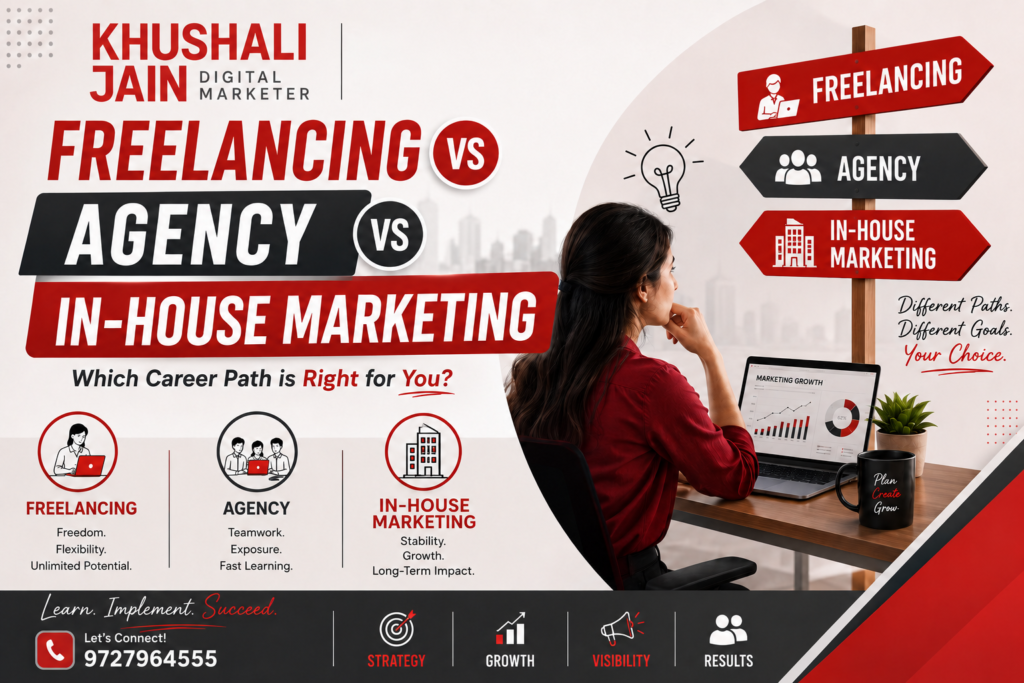
By Khushali Jain – Certified Digital Marketer in Mumba
Introduction
If you’ve recently started learning digital marketing, one question has probably crossed your mind:
“Should I become a freelancer, join a marketing agency, or work in a company?”
It’s a genuine dilemma—and one that almost every aspiring digital marketer faces.
The good news is that there isn’t a single “correct” answer. Each career path offers unique opportunities, challenges, and rewards. The right choice depends on your personality, career goals, financial priorities, and the kind of work environment where you perform best.
Think of digital marketing like learning to drive. The destination may be the same—building a successful career—but there are different routes to get there. Some people enjoy the independence of freelancing, others thrive in the fast-paced environment of agencies, while many prefer the stability and long-term growth offered by an in-house marketing role.
As someone passionate about helping students, professionals, and business owners understand the digital landscape, I’ve seen people succeed in all three paths. The key isn’t choosing the “best” option—it’s choosing the one that’s best for you.
In this guide, we’ll compare freelancing, agency marketing, and in-house marketing in simple language, using practical examples, realistic expectations, and honest advice to help you make an informed decision.
What Are the Three Career Paths?
Before comparing them, let’s first understand what each career path actually means.
Freelancing in Digital Marketing
A freelance digital marketer works independently rather than being employed by a single company. Instead of having one employer, freelancers work with multiple clients, often managing several projects at the same time.
Imagine you’re a family doctor with your own clinic. Different patients visit you for different health concerns. Similarly, a freelance digital marketer works with various businesses, helping each one achieve different marketing goals.
A freelancer may help one client with SEO, another with social media marketing, and a third with Google Ads—all in the same week.
Typical Clients
- Local businesses
- Startups
- E-commerce brands
- Coaches and consultants
- Healthcare professionals
- Real estate companies
- Restaurants
- International clients
How Freelancers Earn
Freelancers usually charge clients in one of the following ways:
- Monthly retainers
- Project-based fees
- Hourly rates
- Consultation charges
- Performance-based pricing (less common)
Daily Routine
A typical day might include:
- Meeting clients
- Creating marketing strategies
- Running ad campaigns
- Writing content
- Preparing reports
- Sending invoices
- Finding new clients
Unlike a regular job, freelancers are responsible not only for delivering work but also for managing sales, communication, finances, and business development.
Agency Marketing
A digital marketing agency provides marketing services to multiple businesses under one organization. Agencies typically have specialized teams handling SEO, content, paid advertising, social media, design, web development, analytics, and account management.
A simple analogy is to think of an agency as a multi-speciality hospital. Different experts work together to solve different problems for different patients. In the same way, agency professionals collaborate to deliver marketing solutions for various clients.
You may work on a restaurant’s Instagram campaign in the morning and an e-commerce brand’s Google Ads campaign in the afternoon.
Agency Structure
Most agencies include roles such as:
- SEO Executive
- Performance Marketer
- Social Media Manager
- Graphic Designer
- Content Writer
- Web Developer
- Account Manager
- Marketing Strategist
This collaborative environment allows professionals to learn from colleagues with different skill sets.
Daily Workflow
Agency life is often dynamic and fast-paced. A typical day may involve:
- Team meetings
- Client discussions
- Campaign planning
- Content reviews
- Performance analysis
- Reporting
- Brainstorming creative ideas
Since agencies serve multiple clients across industries, you’ll likely gain exposure to a wide variety of marketing strategies and business models.
In-house Marketing
An in-house marketer works exclusively for one company, focusing entirely on that brand’s growth.
Imagine you’re the head coach of a sports team. Rather than training different teams every week, your job is to improve the performance of one team over the long term. That’s similar to the role of an in-house marketer.
Instead of dividing your attention across multiple clients, you dedicate your time to understanding one business deeply—its customers, products, competitors, and long-term goals.
Typical Employers
- Startups
- Large corporations
- E-commerce companies
- Hospitals
- Educational institutions
- IT companies
- Manufacturing businesses
- Retail brands
Daily Responsibilities
An in-house marketer may:
- Plan monthly marketing campaigns
- Coordinate with designers and developers
- Manage social media
- Monitor advertising performance
- Improve website SEO
- Analyse customer behaviour
- Work closely with sales teams
- Present marketing reports to management
Because you’re involved with one brand over a longer period, you can see the direct impact of your strategies and contribute to sustained business growth.
Freelancing vs Agency vs In-house Marketing: Detailed Comparison
| Factor | Freelancing | Agency Marketing | In-house Marketing |
|---|---|---|---|
| Income | Variable | Fixed monthly salary | Fixed monthly salary |
| Income Growth | Unlimited but inconsistent | Moderate and experience-based | Stable with annual increments |
| Job Security | Low | Medium | High |
| Flexibility | Very High | Moderate | Low to Moderate |
| Working Hours | Flexible but often longer | Fixed with occasional overtime | Usually fixed office hours |
| Learning Opportunities | Depends on projects | Very High | High but industry-specific |
| Client Exposure | Direct | High | Limited (one brand) |
| Skill Development | Broad and self-driven | Fast across multiple domains | Deep expertise in one business |
| Teamwork | Minimal to moderate | High | High |
| Independence | Very High | Low | Low |
| Work Pressure | Depends on workload | Often fast-paced | Balanced but target-oriented |
| Creativity | High | High | Moderate to High |
| Promotions | Not applicable | Structured career growth | Structured career growth |
| Remote Work | Very Common | Hybrid/Remote/Office | Company dependent |
| Risk Level | High | Medium | Low |
| Best For | Independent professionals | Fast learners | Stability seekers |
Which Option Is Best?
Here’s a quick overview:
- Choose freelancing if you value independence, flexibility, and entrepreneurship, and you’re comfortable with some income uncertainty.
- Choose agency marketing if you enjoy variety, teamwork, and learning at a fast pace while working across different industries.
- Choose in-house marketing if you prefer stability, long-term growth, and becoming an expert in building one brand.
Remember, these paths aren’t permanent. Many marketers move between them during their careers—for example, starting in an agency to build experience, transitioning to an in-house role for stability, and eventually freelancing or launching their own agency.
Freelancing: Freedom with Responsibility
Becoming a freelance digital marketer is a dream for many people. The idea of working from home, choosing your own clients, setting your own schedule, and earning without a salary cap is certainly attractive.
However, freelancing is much more than simply working from your laptop. You’re not just a marketer—you also become your own salesperson, accountant, project manager, customer support executive, and business owner.
Think of freelancing like running your own café. You may be excellent at making coffee, but you also need to attract customers, manage inventory, handle payments, and keep the business running smoothly.
The same principle applies to freelancing.
Advantages of Freelancing
1. Freedom to Choose Your Clients
One of the biggest advantages is having control over the businesses you work with. If you enjoy working with healthcare brands, fashion labels, or restaurants, you can gradually build your portfolio in those niches.
2. Flexible Working Hours
Freelancers usually have the flexibility to decide when and where they work. Some prefer early mornings, while others are most productive late at night.
However, flexibility should not be mistaken for fewer working hours. Meeting deadlines and responding to clients often requires discipline.
3. Unlimited Income Potential
Unlike a salaried job, freelancing doesn’t have a fixed earning limit.
As your expertise grows, you can:
- Increase your pricing
- Offer premium services
- Build monthly retainers
- Work with international clients
- Create digital products or online courses
Your income depends largely on your skills, reputation, and ability to generate leads.
4. Exposure to Different Industries
One month you may work for a dental clinic, the next for a real estate company, and later for an online clothing brand.
This diversity improves your adaptability and broadens your marketing knowledge.
Challenges of Freelancing
While freelancing has many benefits, it also comes with responsibilities that many beginners underestimate.
Finding Clients
Clients don’t usually come automatically.
You’ll need to:
- Build a strong LinkedIn profile
- Create a personal website
- Network consistently
- Ask for referrals
- Share valuable content online
- Attend business events
Marketing yourself becomes just as important as marketing your clients.
Income Can Be Unpredictable
Some months you may have several projects.
Other months may be slower.
This is why successful freelancers maintain an emergency fund and continuously work on client acquisition.
No Paid Benefits
Unlike full-time employees, freelancers generally don’t receive:
- Paid leave
- Medical insurance
- Provident Fund (PF)
- Bonuses
- Gratuity
You need to manage these aspects independently.
Client Management
Some clients communicate clearly and respect timelines.
Others may:
- Delay payments
- Frequently change requirements
- Expect instant responses
- Request additional work without additional payment
Setting clear contracts and expectations is essential.
Skills Every Freelancer Needs
Apart from marketing expertise, freelancers benefit from developing:
- Communication skills
- Negotiation
- Proposal writing
- Time management
- Financial planning
- Personal branding
- Client relationship management
- Sales
These business skills often determine long-term success.
Who Should Consider Freelancing?
Freelancing can be a good fit if you:
✔ Enjoy independence
✔ Like solving different business problems
✔ Are comfortable networking
✔ Can manage uncertainty
✔ Want to build your own brand
✔ Prefer flexibility over routine
Real-Life Example
Imagine Neha, a certified digital marketer.
Instead of joining a company immediately, she begins by managing Instagram pages for two local cafés while also helping a dentist improve their Google Business Profile.
Within two years, her client base grows through referrals. She expands her services to include SEO and Google Ads, eventually earning more than she did in her first salaried job.
Her success wasn’t overnight—it came from consistently delivering value, maintaining professionalism, and investing in her personal brand.
Common Misconceptions About Freelancing
Myth: Freelancers work fewer hours.
Reality: Many freelancers work longer hours, especially during the early stages of their careers.
Myth: Freelancing is easy money.
Reality: Building a sustainable freelance business takes time, patience, and consistent effort.
Myth: You need years of experience before freelancing.
Reality: Even beginners can start with small projects, internships, or local businesses while continuing to learn.
Practical Tips for Aspiring Freelancers
- Build a portfolio before charging premium prices.
- Deliver quality work consistently.
- Request testimonials from satisfied clients.
- Specialize gradually instead of trying to offer every service.
- Invest in learning and certifications.
- Develop a professional online presence.
Agency Marketing: The Best Classroom for Digital Marketers
If freelancing is like running your own business, then working in an agency is like attending an advanced practical training academy.
Agencies expose you to multiple industries, experienced professionals, and fast-moving projects. This makes agency experience highly valuable, especially in the early years of a digital marketing career.
Many successful marketers begin their journey in agencies because they learn quickly and develop a broad understanding of the industry.
Advantages of Agency Marketing
1. Fast Learning Curve
Agency professionals often work with multiple clients across industries such as:
- Healthcare
- Education
- Fashion
- Hospitality
- Finance
- Real Estate
- E-commerce
This variety helps you gain experience much faster than working with a single business.
2. Team Collaboration
Unlike freelancing, agencies have specialists.
You work alongside:
- SEO experts
- Paid advertising specialists
- Graphic designers
- Copywriters
- Developers
- Video editors
Every project becomes a learning opportunity.
3. Strong Portfolio Development
Working on campaigns for different businesses allows you to build an impressive portfolio early in your career.
Future employers and clients value this diverse experience.
4. Structured Career Growth
Many agencies have defined career paths.
For example:
Digital Marketing Intern
↓
Digital Marketing Executive
↓
Senior Executive
↓
Team Lead
↓
Manager
↓
Head of Marketing
Challenges of Agency Life
Agency work is rewarding but can be demanding.
You may need to:
- Meet tight deadlines
- Handle multiple projects simultaneously
- Adapt quickly to client feedback
- Learn new tools regularly
Good organization and time management become essential skills.
Daily Workflow
A typical agency day may include:
- Morning stand-up meetings
- Campaign planning
- Client calls
- SEO audits
- Social media scheduling
- Google Ads optimisation
- Performance reporting
- Internal brainstorming sessions
Every day brings new challenges, which keeps the work interesting.
Who Thrives in an Agency?
Agency life suits people who:
✔ Enjoy teamwork
✔ Like learning continuously
✔ Can adapt quickly
✔ Prefer variety
✔ Enjoy solving different business challenges
Practical Example
Rahul joins a digital marketing agency immediately after graduation.
Within one year, he has worked with restaurants, dentists, schools, and e-commerce brands.
By his third year, he has experience in SEO, Google Ads, Meta Ads, email marketing, and analytics—skills that make him highly valuable in the job market.
His learning accelerates because every new client presents a different marketing challenge.
In-house Marketing: Building One Brand for Long-Term Growth
An in-house marketer works exclusively for one organisation.
Rather than switching between clients, the focus is on understanding one company’s customers, products, competitors, and long-term goals.
Think of it like being a gardener responsible for nurturing one beautiful garden. Instead of caring for many gardens briefly, you spend years helping one flourish.
Advantages of In-house Marketing
1. Job Stability
One of the biggest attractions is predictable income and structured employment.
Employees often receive benefits such as:
- Paid leave
- Health insurance
- Provident Fund (PF)
- Performance bonuses
- Training opportunities
2. Long-Term Strategic Thinking
Since you’re working with one brand, you can plan campaigns months in advance and measure long-term results.
This deeper involvement helps you understand how marketing contributes to overall business growth.
3. Strong Business Understanding
In-house marketers often collaborate with:
- Sales teams
- Product managers
- Customer support
- Leadership
- Finance departments
This gives you a holistic view of how businesses operate.
4. Better Work-Life Balance (in many companies)
While deadlines still exist, many organisations offer more predictable schedules compared to agencies.
This can make it easier to maintain a healthy work-life balance.
Challenges
Working with one brand also means:
- Less exposure to different industries
- Slower variety in projects
- Growth depends on company structure
- Promotions may take time
However, you gain depth instead of breadth.
Who Should Choose In-house Marketing?
This path is ideal if you:
✔ Prefer stability
✔ Enjoy long-term planning
✔ Want structured career progression
✔ Like understanding one business deeply
✔ Value employee benefits
Practical Example
Priya joins the marketing department of an established healthcare company.
Over the next four years, she becomes an expert in healthcare marketing, patient behaviour, and brand positioning.
Her campaigns directly contribute to increased patient inquiries, stronger brand awareness, and business growth.
Rather than working across multiple industries, she develops deep expertise within one sector.
Real-Life Scenarios: Which Career Path Fits You?
Choosing between freelancing, agency marketing, and in-house marketing becomes much easier when you relate it to real situations. Let’s look at a few common examples.
Scenario 1: Riya – A College Student
Riya has just completed a digital marketing certification. She has theoretical knowledge but very little practical experience.
Best Choice: Agency Marketing
Why?
An agency exposes her to multiple clients, tools, and marketing channels in a short period. She’ll receive guidance from experienced professionals and build a strong portfolio.
Takeaway: If you’re a fresher, an agency is often the fastest classroom.
Scenario 2: Aman – The Family Breadwinner
Aman recently got married and supports his parents. Financial stability is his top priority.
Best Choice: In-house Marketing
A full-time corporate role offers:
- Fixed monthly salary
- Employee benefits
- Paid leave
- Long-term career growth
Freelancing may eventually provide higher income, but the uncertainty isn’t ideal for his current responsibilities.
Scenario 3: Priya – Loves Travelling
Priya dreams of working from different cities while exploring India.
Best Choice: Freelancing
As long as she has a laptop and a reliable internet connection, she can work with clients from almost anywhere.
However, she must also be disciplined enough to manage deadlines while travelling.
Scenario 4: Rohan – Loves Teamwork
Rohan enjoys brainstorming, sharing ideas, and collaborating with others.
Best Choice: Agency Marketing
Agencies encourage teamwork between:
- Designers
- Content writers
- SEO specialists
- Performance marketers
- Developers
- Account managers
If you’re energized by collaboration, agency life can be highly rewarding.
Scenario 5: Sneha – Wants to Build Her Own Agency
Sneha’s long-term dream is to start her own digital marketing agency.
Recommended Career Path:
Agency → Freelancing → Agency Owner
Working in an agency helps her understand:
- Client communication
- Team management
- Campaign execution
- Reporting systems
- Project workflows
Later, freelancing allows her to build a personal brand and client base. When she’s ready, she can scale into an agency with confidence.
Common Myths About Digital Marketing Careers
Myth 1: Freelancers Always Earn More
Reality:
Some freelancers earn exceptionally well, but many struggle to find consistent clients.
Income depends on:
- Skills
- Experience
- Reputation
- Networking
- Client retention
A highly skilled in-house marketer or agency professional can also earn an excellent salary.
Myth 2: Agency Jobs Are Only About Stress
Reality:
Agency work is fast-paced, but it also offers some of the best learning opportunities in the industry.
The pressure often comes from handling multiple projects, but it also accelerates professional growth.
Myth 3: Corporate Jobs Aren’t Creative
Reality:
Many companies encourage innovation, experimentation, and creative campaigns.
Creativity depends more on the organisation’s culture than on the job title.
Myth 4: Freelancing Means Working Less
Reality:
Freelancers often work longer hours—especially in the beginning.
In addition to delivering client work, they must market themselves, manage finances, and find new business.
Myth 5: Agencies Exploit Employees
Reality:
Every organisation is different. While some agencies have demanding environments, many invest heavily in employee training, mentorship, and career development.
Research the company’s culture before accepting an offer.
Myth 6: In-house Marketers Stop Learning
Reality:
Marketing platforms evolve constantly. Whether you’re in-house, at an agency, or freelancing, continuous learning is essential.
Salary & Income Expectations in India (Approximate)
Note: Salaries vary based on location, skills, certifications, company size, industry, and performance. The figures below are indicative and may differ.
| Experience | Agency | In-house | Freelancing |
|---|---|---|---|
| Fresher (0–1 Year) | ₹2.5–4.5 LPA | ₹3–5 LPA | ₹10,000–40,000/month (project-based) |
| 1–3 Years | ₹4–7 LPA | ₹5–8 LPA | ₹40,000–1,00,000+/month |
| 3–5 Years | ₹7–12 LPA | ₹8–15 LPA | ₹1–3 lakh/month (with a strong client base) |
| 5+ Years | ₹12–20+ LPA | ₹15–30+ LPA | Highly variable depending on specialization and business scale |
Remember, freelancing income is not guaranteed. Some months may be highly profitable, while others may require more effort to secure projects.
Essential Skills for Every Digital Marketer
Regardless of your chosen path, certain skills are valuable across the industry.
Technical Skills
- Search Engine Optimization (SEO)
- Google Ads
- Meta Ads (Facebook & Instagram)
- Social Media Marketing
- Content Marketing
- Email Marketing
- Google Analytics
- Conversion Tracking
- Marketing Automation
- AI tools for content, research, and productivity
Soft Skills
- Communication
- Time Management
- Problem Solving
- Creativity
- Client Management
- Presentation Skills
- Negotiation
- Adaptability
- Team Collaboration
Business Skills
- Personal Branding
- Networking
- Sales Fundamentals
- Understanding Customer Psychology
- Continuous Learning
Digital marketing isn’t just about using tools—it’s about understanding people, solving business problems, and delivering measurable results.
A Simple Decision Framework
Still unsure which path is right for you? Ask yourself these questions:
Do you enjoy independence and making your own decisions?
→ Consider Freelancing
Do you enjoy learning quickly and working with different industries?
→ Consider Agency Marketing
Do you value stability, structured growth, and long-term planning?
→ Consider In-house Marketing
Can you handle uncertain income while building your business?
→ Freelancing may suit you.
Do you enjoy working with teams?
→ Agency or In-house roles could be a better fit.
Is a fixed monthly salary important to you?
→ In-house marketing is likely the safest option.
Your answers will give you a clearer picture of the environment where you’ll thrive.
Practical Tips for Beginners
Before chasing high-paying roles or clients, focus on building a strong foundation.
- Learn the fundamentals before specializing.
- Build a portfolio with personal, internship, or volunteer projects.
- Create a professional LinkedIn profile.
- Develop your own website to showcase your skills.
- Earn industry-recognized certifications.
- Stay updated with changes in Google, Meta, and AI tools.
- Read blogs, attend webinars, and join marketing communities.
- Network with professionals and seek mentorship.
- Don’t be afraid to start small—every successful marketer began as a beginner.
Key Takeaways
- There is no universally “best” digital marketing career path.
- Freelancing offers flexibility and high income potential but requires business skills and resilience.
- Agency marketing provides rapid learning, diverse experience, and strong career development.
- In-house marketing offers stability, structured growth, and the opportunity to become an expert in one brand.
- Your ideal choice depends on your personality, financial goals, and preferred work style.
- Whichever path you choose, continuous learning and adaptability are the keys to long-term success.
Conclusion
Choosing between freelancing, agency marketing, and in-house marketing isn’t about finding a perfect option—it’s about finding the right fit for your current stage of life and career.
Many successful digital marketers don’t stay in one path forever. They evolve. Some begin in agencies to gain experience, transition into in-house roles for stability, and eventually start freelancing or even launch their own agencies.
The beauty of digital marketing is that it offers flexibility. Your first decision doesn’t have to be your final one.
Focus on building real skills, gaining practical experience, and maintaining a growth mindset. Opportunities will naturally follow.
Whether you’re a student, a career changer, or a business owner looking to understand the marketing landscape, remember that consistency, curiosity, and continuous learning will take you much further than chasing trends or shortcuts.
About the Author
Khushali Jain is a Certified Digital Marketer in Mumbai passionate about helping businesses grow through SEO, Google Ads, social media marketing, content strategy, and performance-driven digital campaigns. Through her blog, she shares practical insights, beginner-friendly guides, and actionable marketing tips to help readers build successful careers and businesses.